
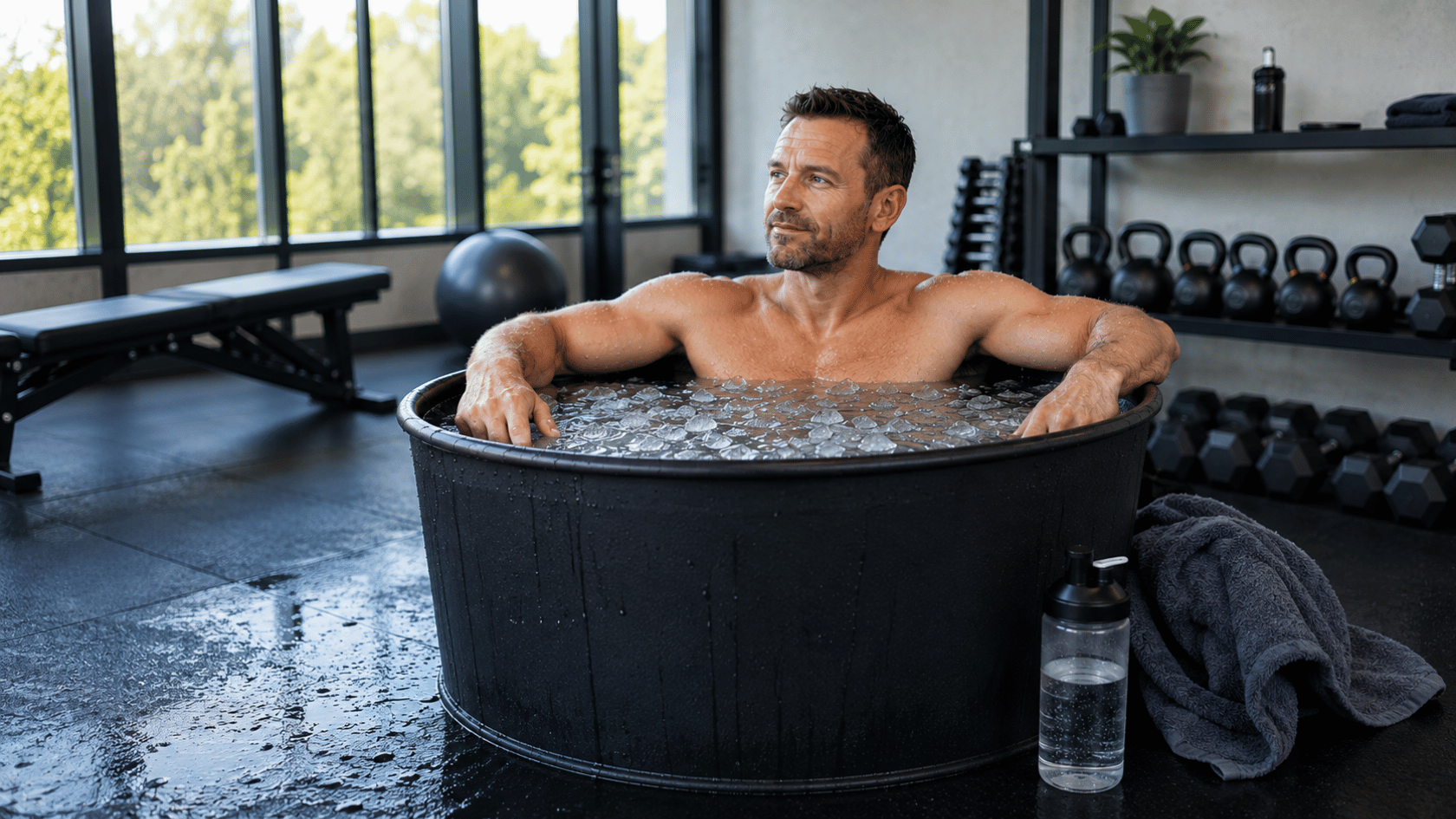
Ice Baths and Recovery: Potential Benefits, Do’s and Don’ts
- Olly
Ice baths and cold-water immersion have become increasingly popular as a recovery tool, with professional athletes and fitness enthusiasts using them after demanding training sessions in the hope of reducing soreness and speeding up recovery.
There is some evidence behind the idea, but the benefits are not quite as straightforward as social media sometimes makes them appear.
Cold-water immersion can help reduce the feeling of muscle soreness after hard exercise and may improve how recovered you feel in the short term, particularly when you need to perform again relatively soon. However, it is not a replacement for the fundamentals of recovery, and using an ice bath after every workout is certainly not necessary.
What can ice baths actually do?
Cold-water immersion appears to be most useful when the main goal is short-term recovery from demanding exercise.
Research has found reductions in delayed onset muscle soreness and some improvements in perceived recovery following cold-water immersion, although the effects vary depending on the type of exercise, timing and protocol used.
This can be particularly relevant for athletes who have another demanding session, match or event coming up within a relatively short period.
For the average person training a few times each week, however, the need for an ice bath is much less compelling.
When cold might not be the best idea
If your main goal is building muscle through resistance training, using cold-water immersion immediately after every strength session may not be ideal.
Some research suggests that regular post-exercise cold-water immersion can blunt some of the adaptations associated with resistance training, including muscle growth, although the evidence is not perfect and more research is needed.
This means that if you have just completed a strength session and your priority is building muscle, you do not necessarily need to jump straight into an ice bath.
Allowing your body to recover naturally may be the better option.
If you want to try one
There is no prize for making the water as cold as possible or staying in for as long as you can.
Cold-water exposure creates a significant physiological response, so starting conservatively makes far more sense than trying to copy an extreme protocol you have seen online.
If you are using an ice bath at home, make sure you can enter and exit safely, avoid doing it alone if there is any risk of becoming unwell, and warm yourself up afterwards.
Open-water dipping carries additional risks and should not be treated in the same way as sitting in a controlled bath. Cold water can trigger an involuntary gasp, rapid breathing and a rise in heart rate and blood pressure, which is why the RNLI recommends acclimatising slowly and never cold-water dipping alone.
The simple do’s and don’ts
Do:
Start conservatively rather than chasing extreme temperatures or long exposure times.
Consider cold-water immersion when short-term soreness or recovery between demanding sessions is the priority.
Continue to prioritise sleep, nutrition, hydration and sensible training, as these remain the foundations of recovery.
Make sure you can safely get in and out of the water and have a warm environment available afterwards.
Don’t:
Assume that colder automatically means better.
Use an ice bath immediately after every strength session if building muscle is your main goal.
Treat an ice bath as a substitute for proper recovery.
Try to prove how long you can tolerate the cold.
Use cold-water immersion without appropriate medical advice if you have a cardiovascular condition or another health concern that could make sudden cold exposure risky. Sudden cold exposure can increase heart rate and blood pressure and place additional stress on the cardiovascular system.
The bottom line
Ice baths can be a useful recovery tool, but they are not a requirement for getting fitter, stronger or healthier.
For most people, good training, adequate nutrition, quality sleep and sensible recovery will have a much greater impact than adding an extreme recovery protocol.
Use cold exposure as a tool when it makes sense, rather than feeling that you need to do it simply because everyone else is.

Like this post? Share it on social media:
Facebook
Twitter
LinkedIn